Friday, April 26, 2013

Interesting Facts About the Medieval Clothing


More and more people is interested in the Medieval clothing fashion now and they dress themselves in the Medieval style clothes. I will simply introduce some interesting facts about the Medieval clothing and you can have a reference if you are interested in this interesting topic.


Nobels and Peasants: Most people in the middle ages wore clothes made of wool or linen. While many peasants made their clothes at home, kings, queens and other members of nobility had their clothes made by tailors. The higher the quality of the material, the more prominent the people who wore the clothes. Kings, queens and other nobles adorned their clothing with jewels and intricately woven silk. Nobles were often distinguished by the longer length of their jackets. Wealthy men often wore hose and jackets with pleats or skirting during the latter part of the middle ages.


About religious orders: The holy order during the middle ages wore woolen habits that resembled the Roman style of clothing. Religious affiliation was distinguished by color. The Benedictines wore black and the Cistercians wore either undyed wool or white. The Poor Clare Sisters, which was an order of Franciscan nuns, petitioned the pope for permission to wear woolen socks.


About the women hair: Married women in the middle ages could be spotted easily. They wore tight caps or nets over their hair, which was fixed in a bun. Unmarried women could wear veils and have their hair hanging loose or braided.
About the Knights and Barbarians: Knights wore sleeveless surcoats decorated with a coat of arms. Barbarian nomads of the time wore simple clothing of wool, fur and sometimes leather (raw animal hide). They also wore trousers. Expensive leather was worn by knights and nobles. The rich often imported silk and turbans from the Far East.
c

Thursday, April 25, 2013

Ideas For Medieval Capes And Dresses


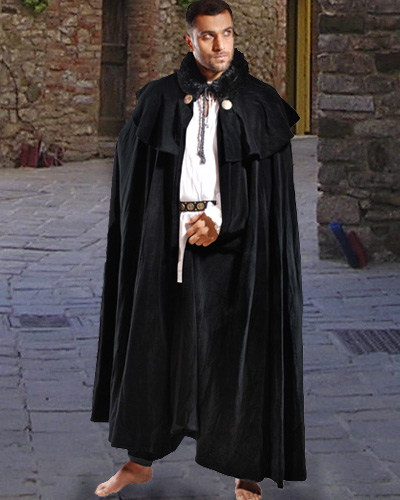
Whether you are participating in a renaissance faire or going to a Halloween party, medieval capes and dresses are popular costume options. The success of Peter Jackson's "Lord of the Rings" films as well as the Pirates of the Caribbean franchise has only strengthened the appeal of bar wench costumes, bodices and knightly riding capes.


Green Renaissance Cloak: Modeled after a 16th century design, the green renaissance cloak is appropriate for both men and women since it can be worn over a dress or a knight's costume. The cloak, which is fastened with a decorative gold pin, is rounded off with a pointy hood to give the costume an added layer of authenticity.


Country Dress: The medieval country dress was worn by servants and peasants and is an ideal costume for outdoor events because it was designed to be comfortable. For underwear, you should consider long gauze bloomers both because of historical accuracy, and because they are made from breathable material that allows you freedom of movement.


Red Hooded Cape: Give your costume a fairy tale quality with a cape that echoes the tale of Little Red Riding Hood. The red hooded cape is unisex and goes well with both leather tunics and lady in waiting costumes. The crushed red velvet hooded cape is a popular style for women as well as men who are dressed as bards or storytellers.

Wednesday, April 24, 2013

Looking Back to The Glory of tne Medieval Clothing


Medieval clothing was very complex, elaborate, stylish and impressive. The wonderful and eye grabbing medieval clothing was in fact really attentive to its type. The very essence of medieval clothing would be to determine one's status quo in the society as well as the power one has. For some reason, fantastic identification is given to the men and women whose medieval clothing was a lot more extremely comprehensive, distinctive or impressive.


Throughout the middle ages, it truly is perfectly normal to wear the tight, unpleasant garments each day. For them, being dressed in such exclusive medieval clothing provides them the pride and confidence that they should have. This might be not comfortable however the medieval clothing contains their particular status, therefore putting them on is worth the pain. However presently, is it still typical to wear medieval clothing each day? Naturally not! Wearing medieval clothing daily nowadays is definitely unconventional or should I say weird. As a matter of fact, we merely employ medieval-like clothes any time attending special events that need us to be dressed in formal attire like wedding ceremonies and balls. Besides that, we use our common t-shirt and denims daily.


A lady from the royalty or the top class is only excused to put on a corset whenever she is in her chamber already. Besides that, she actually is expected to use the tight corset no matter how unpleasant it might feel. However, a merchant's wife has far more freedom in movement since she only wears a heavily boned bodice with no underlying corset. A peasant, who belongs to the lower class system, would certainly wear a simple boned bodice with dull colour. As you go lower in the class system, the everyday utilization of medieval gowns and dresses has turn out to be less typical, both formal and daily wear.

Monday, April 22, 2013

Culture of Medieval clothing


We all love Medieval Clothing; we love to flaunt them in some special occasions and our near and dear ones love to have these Medieval Clothes, Medieval Costumes and Medieval Dresses as gifts on special occasions such as birth days, New Year days and such other occasions.


Nowadays, whereas people have a common liking for the modern dresses, many love to wear fashionable medieval dress, medieval clothes, pirate costumes and renaissance clothing. Some designers even combine the medieval styles with the modern ones and create unique styles. Such a blending of the styles of two ages are loved by the youngsters and they will go to any extent to buy such blended products.


Today Medieval Dresses are getting more and more popular among the people of various ages. These medieval costume are sold out like hot cakes. But there are very few makers of such products. So whenever start selling these pirate clothing or renaissance costumes they become quite popular among the buyers. People say that old fashions die hard. Our old fashions live with us. We love to flaunt these fashions through our dresses. Wearing Medieval Clothing is one way of showing off our attachment with the old traditions and styles.

Sunday, April 21, 2013

Stylish and Elegant Medieval Costumes


Fashion continues to change with time. Throughout history, one can observe that fashion and trends of outfits have continuously changed. The medieval costumes are reputed for their bold design and styles. These costumes are inspired by the medieval era and are very popular for themed parties. These costumes are also in high demand for theatre performances and presentations related to the medieval times or various important events of that era. The medieval outfits and costumes are made with high quality materials. They have intricate detailing and embroideries that represent the fashion and trends of that time. I will share some information and you can have a reference if you are interested in this clothing fashion style.


The medieval outfits are available in many styles and designs. They are also presented in different sizes. Many online companies offer a wide range of exquisite medieval attires and outfits. The companies employ designers who are familiar with the different aspects of medieval fashion. Some online firms also offer suitable accessories like medieval jewelry, which can complete the look and appearance of the outfirt. The costumes are available in many elegant colors, and thus one can choose attires in colors or shades that one prefers. The costumes and outfits inspired by the medieval times look quite attractive and elegant.


Wednesday, April 17, 2013

Medieval Fashion and Medieval Clothing


Are you curious about the dressing style about the Medieval times? Well, medieval clothing can't be when compared to clothing that we have. In the modern times, practically anything can be purchased and worn provided the buyer has enough money. It was different throughout the medieval times particularly as the clothing people wear typically indicates their status inside the society. There are particular colors and farbicsreserved just for royalty. Same complements the peasantry. I will share some information about the Medieval fashion and Medieval clothing with you and you can have a reference if you are interested in that era dressing customes.


Tunics or loose-fitting garment were usually worn by men throughout the Middle Ages. Tunics could be either long-sleeved or sleeveless. How a tunic is worn might be unique to members of the specific social strata, generation or gender. For example, most men usually wear their tunics with their knees, monks and also the elderly and often wear their tunics to the ground. Likewise, kings, noblemen along with other members with the royalty wear their tunics exactly the same during special occasions. Members from the church for example friars wear cloaks with their feet with rope belts with beads that they use for prayers.


Pants which were in the Germans, were opposed from the Romans but were eventually used by the populace. They wore their pants underneath the tunics. Materials useful for pants were the same as the ones useful for the tunics.As for the women, they wear one or more tunic with their ankles. However, women usually do not wear pants. Instead, they'll use woven tights or socks on their legs. Nuns also wear tunics although they only use black and white variants. During the winter weather, wool cloaks were used. Knitting was not yet invented in those days and that's why woven tights were loose-fitting more often than not for this reason.

Monday, April 15, 2013

The History of the Medieval Clothing for Women


I believe most of the people in our society will have an interest in the Medieval era because this era is known for its mysterious and it is one of the most fascinating time periods in history. Many people in our world are interested in the way people lived and looked in the Middle Ages. I will simply introduce some Medieval clothing history for you and you can have a read if you are interested in this clothing fashion style.


Today, many seek out medieval clothes to recreate the magical time of princesses, knights, and castles. Medieval clothing for women is fairly simple compared to other periods, but yet there is something mysterious and mesmerizing about design form that time period. When they think of the Medieval clothing, most people picture flowing dresses and charming headbands, but that wasn't the only type of attire women wore throughout the Middle Ages. The type of clothing women wore and the way they wore them depended mostly on their social status and occupation.


The styles of the late Middle ages are the fashions most people associate with the Medieval period. Today, many women seek replicas of Medieval clothing for women because it's flattering and romantic. Ball gown shapes, rich royal colors and gorgeous gowns are just a few reasons why women love Medieval fashion. Wearing Medieval clothing today is a great way to escape the stresses of modern life and become a princess for a day.